Dual Tissue Handloom Cotton Sarees: Two Shades, One Timeless Weave
Hold a dual tissue handloom cotton saree up to the light and something odd happens — the colour seems to move. Tilt it one way and a warm shade comes forward; tilt it another and a cooler tone slips through from underneath. That’s not a printing trick or a clever dye job. It’s built into the cloth itself, thread by thread, on a handloom, using nothing more than two colours of yarn and a weaver’s steady hand. For anyone who has always loved the glow of a tissue saree but wished it came without silk’s weight — and silk’s price — this fabric closes that gap rather neatly.
It’s having a moment right now, and once you understand what actually goes into making one, it’s easy to see why.
What Exactly Is a Dual Tissue Handloom Cotton Saree?
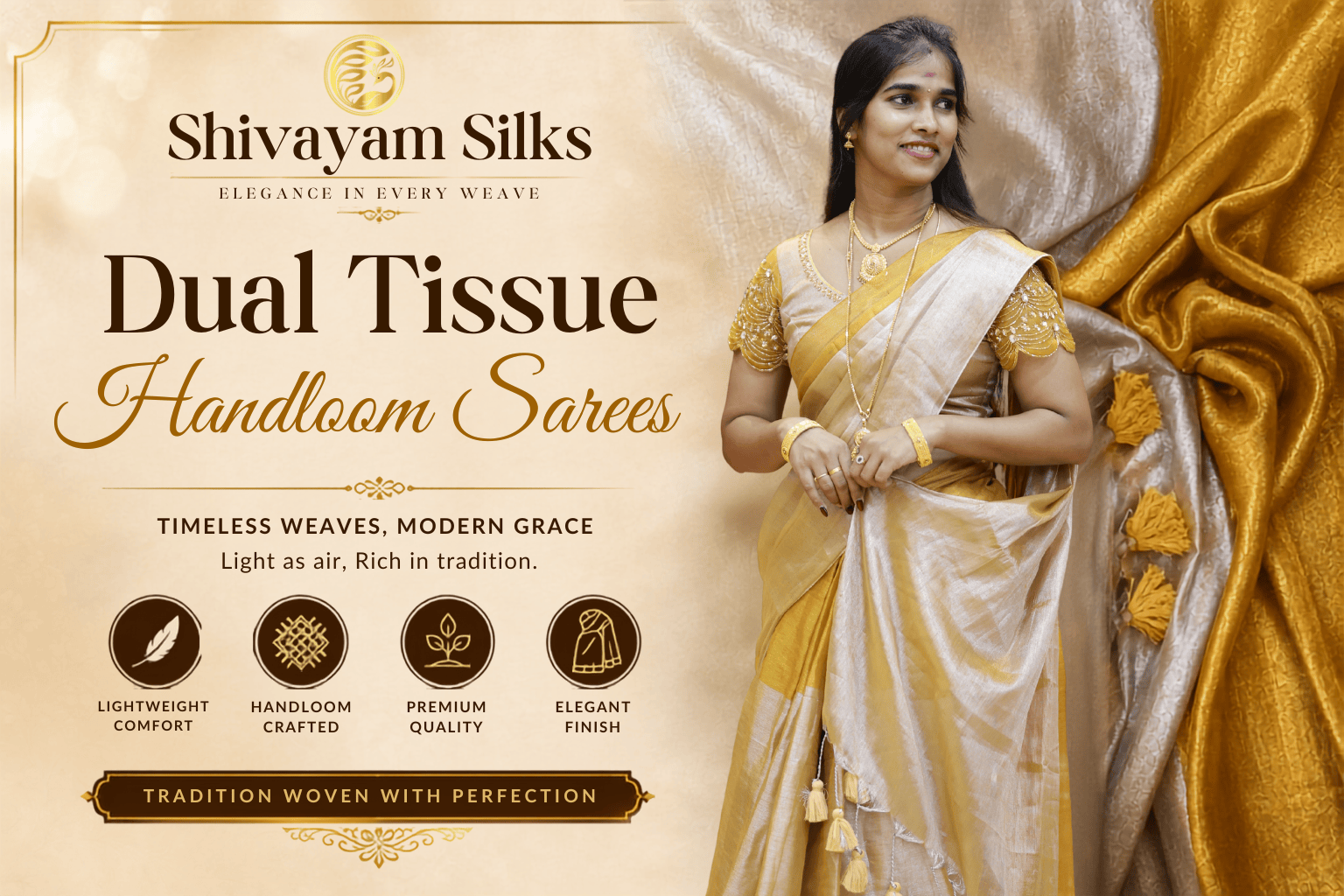
A dual tissue handloom cotton saree combines breathable cotton with a beautiful woven shimmer .“Tissue” refers to fine zari threads woven into the fabric, not added through embroidery .The zari may be gold, silver, copper, or rose-toned .“Dual” means the warp and weft are woven in two complementary colours .This creates a lovely shot-colour effect that changes with the light and viewing angle .The saree offers the comfort and softness of cotton with the shine of silk .Its handloom texture gives it a natural, elegant drape.
It is lightweight, breathable, and suitable for both everyday wear and special occasions.
The subtle colour play makes it look especially attractive in photographs.
Since it is handwoven, every dual tissue cotton saree has its own unique character.
Where This Weave Comes From
Tissue fabric has old roots, with its name coming from the French word tissu, meaning woven cloth.The tradition of weaving fine gold and silver threads into silk dates back to the Mughal era.Varanasi remains one of the most famous centres of zari weaving even today.For centuries, tissue fabric was considered luxurious and reserved for royal and special-occasion wear.Tamil Nadu adds another rich chapter through its historic weaving centres in Kovai and Salem.These regions are known for combining cotton’s comfort with a beautiful, silk-like sheen.The Chettinad region’s Kandangi cotton sarees, recognised with a Geographical Indication tag, reflect over 150 years of weaving heritage.Nearby areas such as Manamedu have also produced cotton sarees featuring subtle zari work and bold borders.Dual tissue handloom cotton brings together the North’s zari tradition and the South’s cotton expertise.It is not a completely new idea, but a graceful meeting of two ancient weaving skills.
Handloom Cotton, By the Numbers
It’s easy to talk about heritage in the abstract. The numbers behind it are worth sitting with for a moment too, because they explain why choosing a handloom — rather than a power-loom imitation — actually matters.
India’s Fourth All India Handloom Census counted 31.45 lakh households across the country engaged in handloom-related work, with 25.45 lakh of those directly operating a loom.
After agriculture, handloom weaving is the largest employment-generating activity in the country.
Roughly 15% of all cloth woven in India still comes off a handloom rather than a power-driven machine — a striking figure, given how industrialised textile production has become almost everywhere else.
Close to 72% of India’s handloom workforce is made up of women, many of them the ones actually setting a dual-tone warp and throwing the shuttle for sarees exactly like this one.
Tamil Nadu alone accounts for close to 1.7 lakh weaving households — the fourth-largest concentration of any state in India, behind only Assam, West Bengal and Manipur.
Globally, the handloom products market was valued at close to $8.95 billion in 2025 and is projected to grow past $20 billion by 2034, expanding at nearly 10% a year — and sarees alone are expected to account for almost 45% of that market in 2026.
On the export side, the United States remains the largest overseas buyer of Indian handloom goods, with the UAE, Netherlands, France and the UK making up the rest of the top five.
Why This Weave Is Special
A few things set dual tissue handloom cotton apart from both plain cotton and traditional silk tissue.
It’s cooler to wear than silk, full stop — which matters enormously in Indian weather, whether that’s a Salem afternoon or a wedding hall packed with two hundred relatives. At the same time, it doesn’t look “plain” the way an ordinary cotton saree sometimes can. The colour-shift does a lot of the visual work on its own, so you don’t need heavy embroidery or embellishment to make the saree feel festive.
It’s also genuinely versatile. The same saree that looks understated in office lighting can look considerably richer under the yellow lights of an evening function, simply because the dual-tone effect responds to light differently. And because it’s handwoven, small irregularities — a slightly uneven zari line, a subtle shift in weave tension — are part of the character rather than a flaw. A machine can’t replicate that, no matter how good the imitation.
The Beauty at Shivayam Silks
We’ve always thought the best way to showcase a weave like this is to get out of its way. Every dual tissue handloom cotton saree in our collection is chosen with the colour pairing front and centre, because with this fabric, the whole point is how the two tones sit together and shift against each other — a poorly matched pair simply won’t sing the way a well-matched one does.
We look for weaves where the zari is fine enough to shimmer without overpowering the softness of the cotton underneath, and borders that complement the dual-tone body rather than compete with it. It’s a small thing to get right, but it’s the difference between a saree that looks good in a photograph and one that looks good on you, moving, in actual daylight.
Why Choose Shivayam Silks
We source with authenticity in mind, so what you’re buying is genuine handloom work, not a power-loom copy dressed up in handloom language.
Every piece is checked for weave quality, colour consistency and finishing before it reaches you.
We’re based right here in Salem, in a region that has understood the relationship between cotton and sheen for generations — this isn’t a fabric we learned about from a catalogue.
Choosing handloom from us means your money is going toward keeping a shrinking, skilled craft alive, not just buying a saree.
We’re happy to help you pick colours, borders and blouse pairings suited to your skin tone and the occasion, rather than leaving you to guess.
Varieties You’ll Find in Dual Tissue Handloom Cotton
The dual-tone principle stays the same across every version, but the effect changes quite a bit depending on how the two colours are chosen.
Soft, tonal pairings — beige against dusty pink, or two shades of grey — for an understated, everyday-elegant look that works well for office wear or daytime functions.
Bold contrast pairings — maroon warp against gold weft, or deep teal against copper — for festive wear, where you want the colour-shift to be unmistakable from across a room.
Plain-bodied sarees where the dual-tone effect carries the whole design, paired with a contrast zari border for a clean, modern look.
More heavily worked pallus with small woven buttis scattered through the body, for something closer to traditional festive wear.
Styling Tips
Let the saree’s shimmer do the talking — simple jhumkas and a slim necklace usually work better than a heavily layered look.
A contrast blouse, or one in crushed chiffon, sits particularly well against the dual-tone body — it gives the eye somewhere else to land without competing with the saree’s colour-play.
For daytime or office wear, drape it with clean, simple pleats and pin the pallu neatly; for evenings, a looser, slightly draped pallu lets the fabric’s colour-shift show off more as you move.
It transitions easily from day to night — the same saree can go from a work event to a dinner with nothing more than a blouse and jewellery change.
Equally at home at a morning puja, a family function, or a smaller wedding event where you want to look festive without going full silk.
How It’s Made — Inside the Weaving Process
The weaving process begins by dyeing the cotton yarn for the warp in one shade and the weft in a complementary tone.Choosing the right contrast requires skill, as the colours must look balanced and intentional.After drying, the warp threads are carefully mounted on a pit loom or frame loom.The weft threads are then loaded onto shuttles for weaving.Zari is woven directly into the fabric rather than being printed or embroidered later.It is added at regular intervals so that it reflects light evenly across the saree.The weaver works the shuttle and treadles together in a steady handloom rhythm.Depending on the design, a saree may take several days or even weeks to complete.Unlike power looms, handlooms create subtle variations through human control of tension and movement.A gentle zari tug test can sometimes help identify genuine handloom work, as quality zari is less likely to snap or fray.
Why It’s So Popular Right Now
Dual tissue handloom cotton sarees are popular because they perfectly match today’s shift toward subtle, textured luxury. After years of heavily embellished and logo-focused festive wear, people are choosing fabrics that create beauty through their natural texture and colour. The gentle colour-shifting effect of dual tissue makes these sarees look elegant without relying on excessive sequins or embroidery. They are also a practical choice for weddings and festive occasions. Plain cotton can appear too casual, while full silk tissue may feel too grand and expensive for smaller celebrations. Dual tissue handloom cotton offers a comfortable middle ground between everyday wear and luxurious festive fashion. It looks festive enough for a function while remaining light and comfortable for several hours. Younger buyers appreciate it for being sustainable, artisan-made, and different from fast fashion. Older generations value it because handloom cotton feels breathable and comfortable, especially during warm Tamil Nadu afternoons. In the end, both generations are drawn to the same saree for its beauty, comfort, tradition, and timeless appeal.
In the End
A dual tissue handloom cotton saree isn’t trying to be silk, and it isn’t trying to be plain cotton either. It’s its own thing — built from two colours, two regional traditions, and a fair number of hours at a handloom, all so the fabric can do something as simple as catch the light a little differently as you walk. That’s a lot of quiet skill packed into six yards of cloth. Worth trying on, at the very least, just to see the colour-shift for yourself.